
Updated October 23, 2026: updated to describe how Mera Kharcha works today.
In short: Most overspending isn't about money — it's about feelings. Stress orders biryani. Boredom scrolls Myntra. Loneliness upgrades to the bigger plan. Then guilt makes you avoid your bank app, which makes next month worse. Willpower doesn't break this loop; seeing your own patterns does. This is about how emotional spending works, why UPI made it easier than ever, and how to change it without shame.
It's Friday. It's 11 PM. You're Not Even Hungry.
But the phone is in your hand, and the app is open, and the cart fills itself. ₹449. Delivered in 31 minutes. You eat half of it.
Or maybe your version is different. The 1 AM Myntra scroll after a bad day at work, where "just looking" becomes ₹1,299 at checkout. The third coffee order this week from the expensive place, because the meeting went badly. The cab you took instead of the metro because you were just… done.
None of these purchases make sense on a spreadsheet. All of them make perfect sense to the person making them at that moment. Because in that moment, you weren't buying food or clothes or a ride.
You were buying relief.
Spending Is Rarely About the Thing
Here's what nobody tells you about money: your bank statement is secretly a diary. Every line on it records not just what you bought, but how you were feeling when you bought it.
Stressful week? The food delivery total goes up. Fight with someone you love? Shopping apps suddenly get interesting. Bored on a Sunday? Somehow ₹800 disappears into small nothings. Got the appraisal you wanted? You "deserve" the splurge — and honestly, sometimes you do.
Psychologists have a name for the mechanism: spending gives a small, immediate hit of reward — a moment of control, comfort, or celebration that your brain learns to reach for automatically. It's the same reason "retail therapy" is a joke that everyone understands. The purchase is real, but it's standing in for something else.
This is not a character flaw. It's not being "bad with money." It's being human, with a payment method that never says no.
UPI Removed the One Thing That Protected You: The Pain of Paying
Your grandparents felt money leave. Notes counted out of an envelope, handed over, gone — researchers literally call it "the pain of paying," and it acted as a natural brake. You felt ₹500 leaving your hand.
Now? A tap. A face scan. Done before the feeling can catch up. UPI made payments three seconds long, and in doing so, it quietly deleted the pause where second thoughts used to live.
This matters more in India than almost anywhere else, because no country adopted instant payments as completely as we did. The chai is UPI. The auto is UPI. The 2 AM craving is UPI. Each tap is painless. And painless spending is invisible spending — the ₹47s and ₹249s never register as "real money" the way a ₹2,000 note leaving your wallet would have.
So when people say "just spend less," they're missing the point. The system around you was engineered — brilliantly — to make spending effortless. Expecting raw willpower to beat frictionless one-tap checkout is like expecting a diet to survive inside a sweet shop.
The Guilt Loop That Keeps You Stuck
Here's the part that actually does the damage, and it isn't the ₹449 order. It's what happens after.
You feel a pinch of guilt. Guilt makes looking at your bank app unpleasant. So you stop looking. Days pass. The picture gets blurrier. The blurrier it gets, the scarier looking becomes — until the low-balance SMS forces the issue, usually around the 24th, usually at a bad time. Panic, resolution, "next month will be different."
Next month is not different, because nothing about the loop changed:
- Spend — to soothe a feeling
- Guilt — a low hum of "I shouldn't have"
- Avoid — stop checking, because checking hurts
- Shock — the balance reveal, the panic
- Repeat — with extra stress, which means extra spending
Notice what's driving the loop. It isn't the spending. It's the not looking. Shame thrives in the dark. Every month you can't see clearly is a month the pattern runs unopposed.
Awareness Beats Willpower. Every Time.
Here's the gentle, slightly boring truth that actually changes things: people don't fix their spending by becoming stricter. They fix it by seeing it.
There's a reason for that. A rule — "no more online shopping" — fights your emotions head-on, and your emotions have home advantage at 11 PM. A pattern, though, changes the conversation entirely. When you can see that food delivery spikes every Thursday and Friday, that's not a moral failing to punish — it's information. Ah. End-of-week exhaustion. That's what this is.
And information does something shame never can: it lets you make a real choice. Maybe you decide Friday biryani stays — it's ₹450 of genuine joy and you're keeping it. Maybe you decide the three forgotten ₹199 subscriptions go. Maybe you notice the "bored Sunday" pattern and plan literally anything for Sunday. You're not restricting yourself. You're negotiating with yourself, with the facts on the table.
The people who feel calm about money aren't the ones who spend the least. They're the ones who are never surprised.
You Can't See Patterns You Have to Log Manually
The catch, of course: seeing your patterns requires data, and nobody — nobody — logs their spending manually for more than a week. Especially not the emotional spends. The ₹449 order you feel slightly guilty about is precisely the one you'll "forget" to enter.
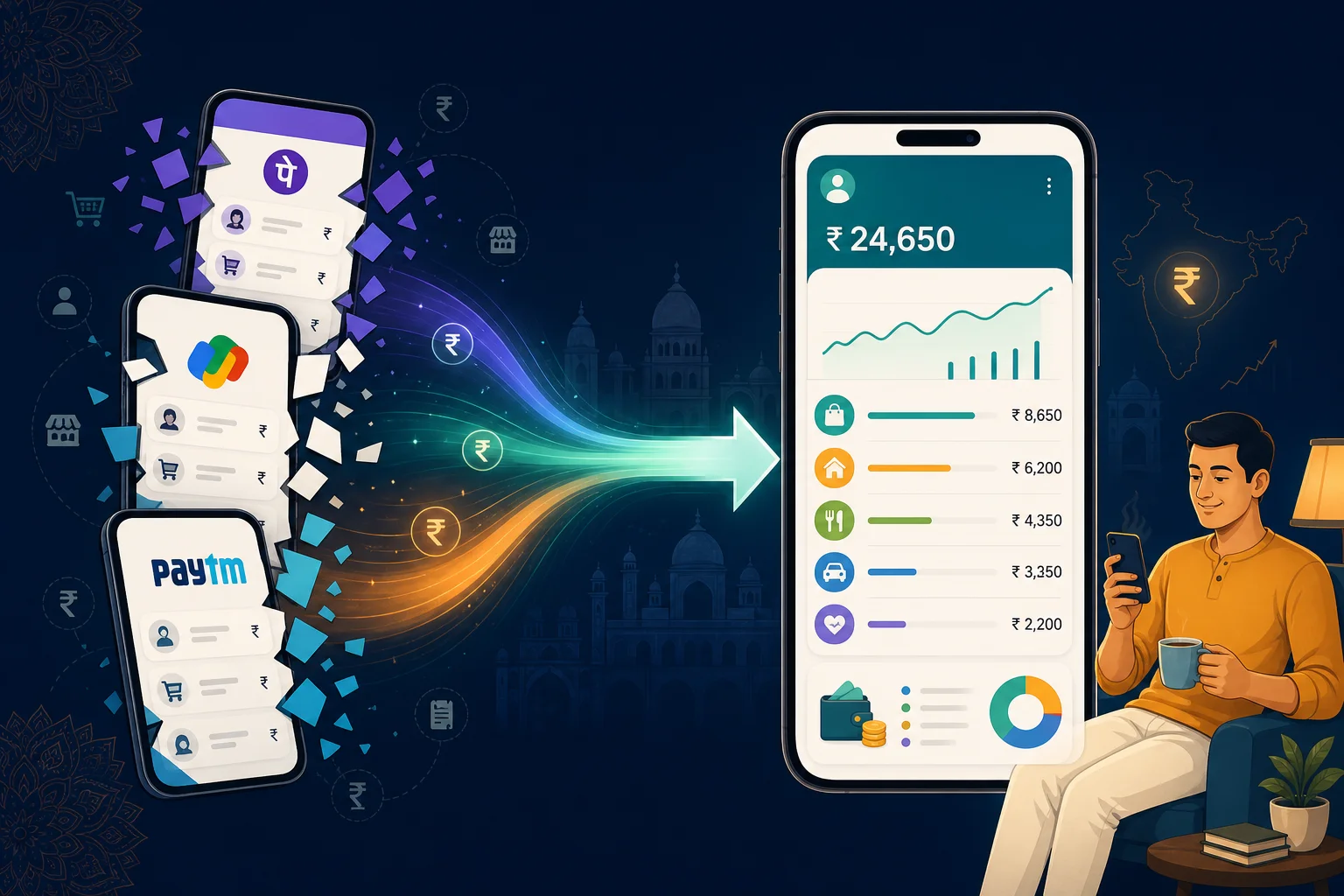
This is where automatic tracking stops being a convenience and becomes the whole point. With Mera SMS and Auto-track payments turned on, the bank and UPI transaction SMS your phone already receives (every PhonePe tap, every Google Pay transfer, every card swipe that texts you) turn into the picture you've been avoiding:
- Category totals — what food, shopping, and transport actually cost you this month
- Merchant breakdown — the honest Swiggy number, the honest Amazon number
- Month vs month — is the pattern growing or shrinking?
- Every small tap counted — the ₹47s that never felt like money
It works even on the days you forget the app exists, which, if you've read this far, you know is the only kind of tracking that survives contact with real life. There's no bank login, and everyday tracking is free.
And when you're ready to actually face a number, you don't have to dig for it. Ask the built-in AI Assistant directly: "How much did I spend on food delivery this month?" — in plain language, English or Hindi. Sometimes hearing the number plainly, without scrolling through the evidence, is the kindest way to meet it.
See Your Spending Patterns — FreeA Kinder Way to Start, Tonight
Not a 12-step budget overhaul. Three small things:
1. Look, once, without judgment. Open your spending for this month — all of it — and just read it like it belongs to a friend you're fond of. No verdicts. You're collecting information, not evidence.
2. Find one pattern and name its feeling. "I order food when work runs late." "I shop when I'm bored on weekends." One pattern. Naming it out loud takes away half its power, because next time it triggers, you'll recognise it mid-tap.
3. Keep one joy on purpose. Pick one "unnecessary" spend that genuinely makes you happy and declare it official. Budgeted joy isn't a leak — it's the thing that makes the rest sustainable. Deprivation is why most budgets die by the 10th.
That's it. Not spending less by force. Spending on purpose — because for the first time, you can actually see what you're doing.
The 11 PM order was never about hunger. But the moment you can see that clearly, without flinching — that's the moment it stops being in charge.
Common Questions About Emotional Spending
Why do I overspend even when I know I shouldn't?
Because overspending isn't a knowledge problem — it's an emotional one. Spending gives an instant hit of relief or reward, and stress, boredom, and loneliness learn to reach for it automatically. UPI removed the friction that used to give you a moment to reconsider. The fix isn't more willpower; it's making the pattern visible so you can catch it before the month ends.
What is emotional spending?
Emotional spending is buying in response to a feeling rather than a need — ordering food when stressed, shopping when bored or sad, splurging to cope or celebrate. The purchase is real, but it's standing in for comfort, control, or distraction. It's extremely common, and it isn't a character flaw.
How do I stop impulse spending on UPI and online shopping?
Three things beat willpower: make spending visible again with an automatic tracker so every tap shows up in one place; add friction back — remove saved cards, log out of shopping apps, use a 24-hour rule for non-essentials; and name the trigger — pause to ask whether you're actually hungry or actually stressed before paying.
Does tracking expenses actually change spending behaviour?
Yes, and automatic tracking works where manual tracking fails. When people see a real monthly number for a category, like ₹3,800 on food delivery, they adjust naturally without being lectured. With SMS auto-tracking through Mera SMS, Mera Kharcha builds that picture from your bank and UPI payment messages, so the feedback loop keeps working even when you forget about it.
What is the best free app to understand my spending habits in India?
Mera Kharcha is a free Android app made for India. It turns your payments, added by you or brought in from bank and UPI SMS through Mera SMS, into patterns: category totals, merchant breakdowns and monthly comparisons. With Premium, its AI Assistant answers questions like "how much did I spend on Swiggy this month?" in your language. No bank login.