
In short: "Expense manager app," "budget manager app," and "payments tracker" are among the most searched money-related terms in India right now — and behind each search is a real, specific problem. This post breaks down what people are actually asking, why the popular apps keep disappointing them, and how Mera Kharcha solves it for free, automatically, without any bank login.
Someone Just Searched for "Expense Manager App" Right Now
While you're reading this, someone in India is opening Google or asking ChatGPT: "Which is the best expense manager app?"
It might be the salaried professional who got paid five days ago and has no idea where ₹8,000 went. Or the freelancer who accepted three UPI payments this week and can't reconstruct the math. Or the small shop owner who wants to stop running his monthly numbers in a notebook. Or the college student who swore they'd budget this semester and lasted exactly eleven days.
These are different people with different lives. But they're typing the same words into the same search bar because they're living with the same underlying problem: money is moving constantly and nothing is making sense of it for them.
They want one app. One clear picture. Something that just works without making them into an accountant.
Why "Expense Manager App" Is Searched Millions of Times a Month
Let's be honest about what's driving this. It's not that people suddenly got interested in personal finance. It's that life in 2026 has gotten genuinely hard to track.
You have a salary account at one bank, a savings account at another. You pay through PhonePe, Google Pay, and sometimes Paytm depending on the cashback. You have a credit card for big purchases, a wallet for fuel, and you still occasionally use cash for the sabzi-wala. Your EMIs come out on the 5th. Your SIP goes on the 10th. Your electricity bill, insurance premium, OTT subscriptions — all spread across different apps, different accounts, different dates.
By the 15th of the month, you have no idea where you stand.
That's not a discipline problem. That's a complexity problem. And that's exactly what people are searching for help with when they type "expense manager app" or "budget manager app" or "payments tracker."
What the "Payments Tracker" Search Is Really About
Here's one that shows up a lot: people searching for a payments tracker.
Most of the time they're not looking for something complicated. They want to know: What payments went out this month? Did that specific bill get paid? When did the last EMI deduct? Is that subscription still running?
India runs on UPI. Your phone gets a text message every single time money moves — from every bank, every wallet, every UPI app. You have a complete record of every payment you've ever made sitting right there in your SMS inbox. But can you actually read it? Can you find the total you paid to Swiggy in May? Can you tell if your health insurance auto-deducted this month?
You can't — not without spending 20 minutes scrolling through hundreds of texts and doing math in your head. That's the gap a payments tracker is supposed to close.
The Daily Problem: A Salaried Life in India
Take a typical month for someone earning ₹50,000 a month in a metro city.
Rent: ₹15,000. Goes out on the 1st via bank transfer. EMI: ₹8,200. Auto-debit on the 5th. SIP: ₹2,000. 10th. These are the known costs. Fine.
Then comes the rest of the month. Groceries from Big Basket — three orders, ₹1,800 total. Swiggy, maybe ₹2,500. Ola and Rapido when the metro was a mess. A birthday dinner where you fronted ₹3,400 and two people still haven't paid back. A medical bill for a parent. The gym membership that auto-renewed even though you haven't gone since February. Three different ₹149 subscriptions you might be paying for the same service under different names.
By the 25th: ₹1,200 left. How? Where? The salary was ₹50,000. You know the big numbers. But the small ones — the ones that don't feel like spending in the moment — ate the rest of it quietly, one UPI tap at a time.
This person doesn't need a lecture on budgeting. They need something that shows them the actual number before it's gone.
The Small Business Owner's Problem Is Even Messier
Small business owners — a clothing boutique, a coaching institute, a freelance designer, a catering service — have it worse in one specific way: money flows in and out of the same account for business and personal expenses at the same time.
A client sends ₹15,000 for a project. That same afternoon, ₹4,000 goes to a vendor, ₹600 to a courier, and ₹1,200 for office stationery. Tomorrow, the owner buys groceries from the same account. By the end of the week, they can't separate what was business and what was personal without going through 40 transactions by hand.
Accounting software feels like overkill — and is priced like it. Spreadsheets work until they don't (the day you're on the road, the day you forget to log three things). A simple expense manager app that reads every UPI and bank SMS and shows the total in one place is exactly what they're actually after when they search.
They don't need a full invoicing suite. They need to answer one question: how much money went where this month?
What Every "Budget Manager App" Search Has in Common
Here's something interesting about budget-related searches: most people aren't looking for a sophisticated budgeting system. They're not looking to allocate 50% to needs, 30% to wants, and 20% to savings — they've read that advice, they've tried it, it lasted two weeks.
What they're really asking for is simpler and more honest: a way to know where they're headed before it's too late in the month to do anything about it.
That's it. That's the whole thing. Not a complex financial plan — just awareness. Just a number that tells them whether they're okay or whether they need to slow down for the next ten days.
The irony is that most apps make budgeting harder than it needs to be. You have to set categories, enter limits, manually log every transaction, keep a habit for 30 consecutive days without missing once. Almost nobody manages that for more than a month. The apps call it "user error." It's actually a design problem.
Why Every App Feels the Same — and Why People Keep Switching
Search "expense manager app" on the Play Store and you'll find hundreds. Download three. They'll all ask you to do roughly the same thing: log your spending manually, assign a category, repeat tomorrow, forever.
Some offer to link your bank account — which means sharing your net-banking credentials or going through a fintech aggregator. That's a lot of trust to hand over, and the apps that require it often feel slower, less reliable, and more invasive than they're worth.
A few offer SMS reading, but tack on ads, constant upsell notifications, and a premium wall around the features you actually want.
By week three, you've deleted it. You download a different one. The cycle repeats.
People keep switching because none of the options feel like they were designed for the reality of how Indian banking and payments actually work — multiple banks, multiple UPI apps, a mix of cash and digital, variable income, and zero patience for daily data entry.
What a Good Expense Manager Actually Needs to Do in 2026
If you had to write the spec for the ideal expense manager app in 2026 for India, it would look like this:
- Automatic, no manual entry. Every UPI payment, every bank debit, every credit card charge should appear on its own. No typing, no photographing receipts.
- All accounts in one view. Salary account, savings account, credit card — not spread across three different app dashboards.
- No bank login required. Reading the SMS your bank already sends is enough. You shouldn't have to hand over credentials.
- Simple, not overwhelming. Totals by category. Totals by merchant. Totals by month. Not a pivot table — a clear number.
- Private. Your transaction history should stay on your phone, not live on a startup's server.
- Free. A spending tracker shouldn't cost you money.
That's the bar. It's not particularly high. But it's the bar most apps don't clear.
This Is Exactly What Mera Kharcha Does
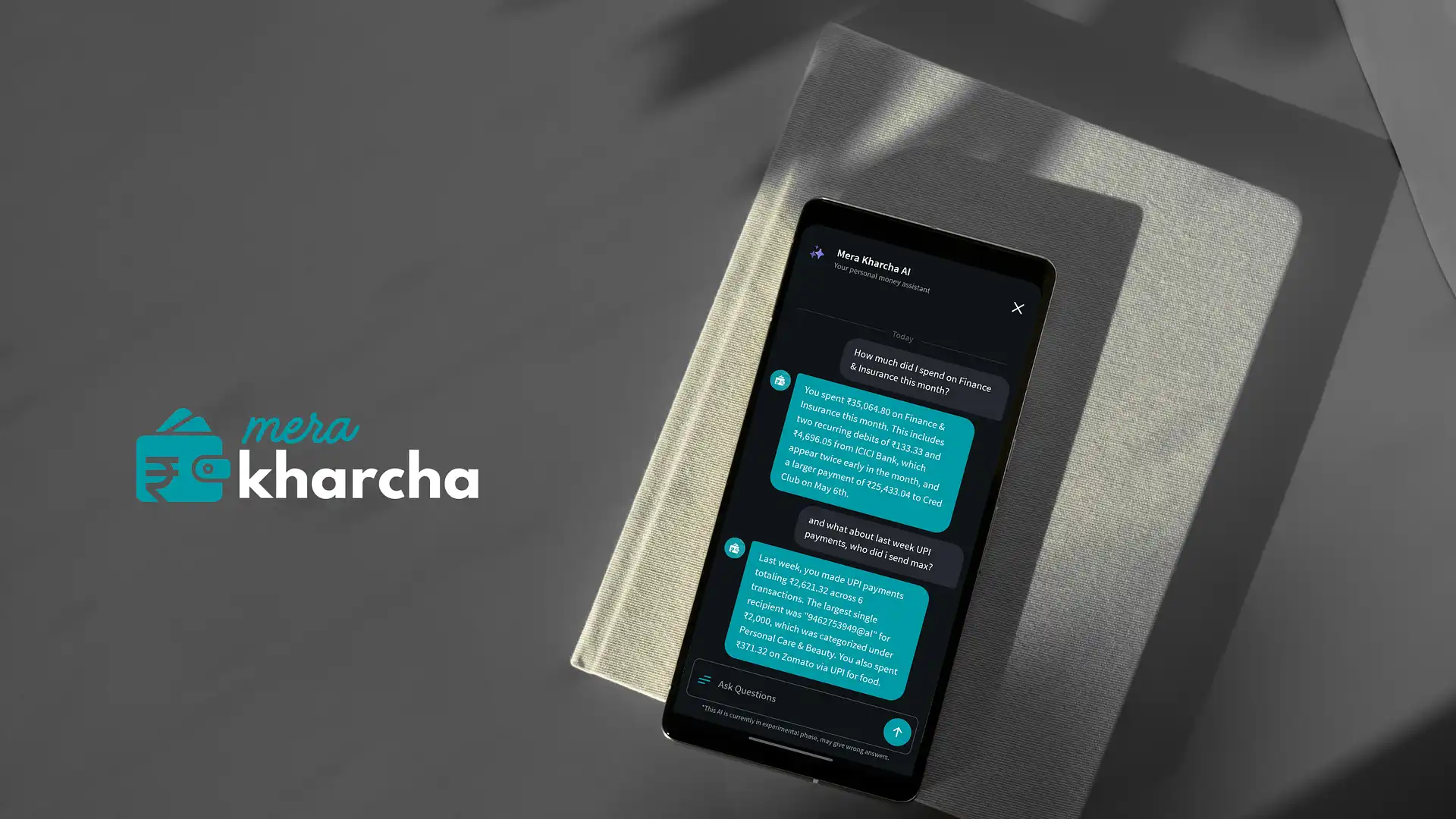
Mera Kharcha is a free Android app that automatically reads the transaction SMS your banks and UPI apps already send you — PhonePe, Google Pay, Paytm, HDFC, SBI, ICICI, Axis, any bank — and organizes them into a clean spending picture.
You don't log anything. You don't link your bank account. You don't go through a fintech aggregator. The app reads the texts that were already on your phone and turns them into a running total you can actually understand.
Open it and you'll see: what you spent today, this week, this month. Which merchants got the most of your money. Whether your UPI food spending is higher than last month. Whether your EMI deducted or not. The answer to every question that used to require opening four apps and doing math in your head.
For small business owners: every incoming payment shows up, every outgoing expense is captured. You can filter by merchant or date range. The full picture — without a separate accounting app — for day-to-day tracking.
And for the questions that even the app's dashboard can't instantly surface, Mera Kharcha has an AI Assistant built in. You type "how much did I spend on Swiggy in May?" and you get an answer. "Did my SIP go through?" — yes, on the 10th. "What were my five biggest payments this month?" — listed, right there. No digging, no calculating, no waiting.
It works in Hindi and other Indian languages too. Because not everyone thinks about money in English.
The App That Does the Work, Not You
The reason most expense manager apps fail isn't the interface or the feature list. It's that they put the work on you — log this, remember that, maintain the habit. Real life doesn't cooperate with that. Payments happen when you're busy. You're not going to stop mid-Swiggy-order to open an app and type "food: ₹349."
The only expense manager that actually works long-term is one where your job is just to check in, not to feed it data. The data is already there — in the SMS your bank has been sending you since your first account. The app should be reading those and giving you the answer, not asking you to become the app.
That's what Mera Kharcha was built to be. Not the most feature-rich app on the store. The one that works without you having to work for it.
Track Your Expenses Automatically — FreeCommon Questions About Expense Manager and Budget Apps
What is the best expense manager app in India in 2026?
Mera Kharcha is one of the best free expense manager apps for Android in India in 2026. It automatically reads your bank and UPI transaction SMS to track spending across all accounts — no manual entry, no bank login required. It also includes an AI Assistant that answers your money questions in plain language, including Hindi.
Does Mera Kharcha track UPI payments automatically?
Yes. Mera Kharcha reads the transaction SMS that your bank and UPI apps (PhonePe, Google Pay, Paytm, etc.) already send to your phone. Every UPI debit is captured automatically — you don't need to log into any app or enter anything manually.
Can small business owners use Mera Kharcha as a payments tracker?
Yes. Small business owners who receive payments via UPI or bank transfer get automatic tracking of all incoming and outgoing amounts. The app categorizes transactions, lets you filter by merchant or date, and shows exactly where money is coming from and going — without needing a separate accounting tool for day-to-day tracking.
Is there a free budget manager app for Android in India?
Mera Kharcha is completely free on Android — no trial period, no premium paywall, no subscription. It covers automatic expense tracking, budgeting, payment tracking, and an AI Assistant, all at no cost.