
In short: Start from your in-hand salary. Look at the last 3 months of kharcha, cash included. Pay the fixed bills and your savings first, on salary day. Give the rest a monthly budget, split into a few categories like ration, doodh-sabzi and eating out. Then check one number every few days: what's left, divided by the days left.
Salary comes on the 1st. By the 20th, the account looks thin, and nobody can say where it went. Rent and EMI are easy to remember. It's the ₹60 doodh, ₹200 sabzi, ₹150 auto and the Zomato order on a tired evening that quietly eat the month. If that sounds familiar, read why the salary is gone by the 20th as well.
A ghar ka budget doesn't need a spreadsheet or a finance degree. It needs six steps and about an hour, once. Below are the steps, then three real-looking budgets for ₹20,000, ₹30,000 and ₹50,000 a month that you can copy and change.
Step 1: Start from the money that actually reaches you
Use your in-hand salary, not CTC. That's the amount in your bank account after tax, PF and other deductions. If anyone else at home earns, or you get rent, tuition fees or a pension, add it. That total is your monthly income, the top line of the budget.
Step 2: Look at the last 3 months of kharcha
Don't guess. Open your UPI apps and bank statement and note what went out in the last three months. Then add the cash you remember: doodh, sabzi, auto, kaamwali, the kirana shop. Most families find their real ghar kharch is 15 to 20% more than they thought, mostly in small cash and UPI payments.
Our guide on checking UPI payment history in PhonePe, GPay and Paytm shows where to find it.
Step 3: Fixed kharche first
These come every month whether you like it or not, so they go in first:
- Rent or maintenance
- EMIs (home, bike, phone, personal loan)
- School or college fees (divide the yearly fees by 12)
- Money you send home to parents
- Insurance premiums (yearly amount ÷ 12)
- Phone, internet and subscriptions
Try to keep EMIs under 40% of your in-hand salary. Above that, almost every month will feel short, however careful you are.
Step 4: Take out savings on salary day
If savings are whatever is left at the end of the month, there will be nothing left. Move it on the day the salary comes: an RD, a SIP, or a separate savings account you don't spend from. Aim for 20%. If that's not possible yet, start with 10% or a fixed ₹2,000 and raise it with every increment. Build an emergency fund of 3 to 6 months of expenses before anything else.
Step 5: Give the rest a budget, by category
What's left after fixed bills and savings is your spending money for the month. Split it into a few categories, not thirty:
- Ration: atta, chawal, dal, oil, masale
- Doodh, sabzi and fruit
- Gas, bijli and paani
- Travel: petrol, auto, metro
- Eating out and food delivery
- Shopping and personal care
- Medicine and doctor
Give each one an amount from what you saw in step 2. Then pick the one or two that always run away (for most of us it's food delivery or shopping) and watch those closely.
Step 6: Check one number every few days
A monthly budget is too big to feel. A daily number isn't. Take what's left for the month and divide it by the days left, including today. ₹6,500 left on the 21st of a 30-day month is ₹650 a day for 10 days. If yesterday went over, the next days get a little less. That's the whole method.
Not sure how to split your salary at all? The 50/30/20 rule is a good place to start: 50% needs, 30% wants and 20% savings, adjusted for high rent.
Budget for a ₹20,000 salary
A family of three in a smaller city, renting a 1BHK. Tight, but it works when every rupee is written down.
| Kharcha | Per month |
|---|---|
| Rent | ₹5,000 |
| Ration | ₹3,500 |
| Doodh | ₹1,500 |
| Sabzi and fruit | ₹1,500 |
| Gas cylinder | ₹900 |
| Bijli and paani | ₹800 |
| Phone and internet | ₹500 |
| School fees and books | ₹1,500 |
| Travel | ₹1,000 |
| Medicine | ₹500 |
| Eating out and shopping | ₹1,300 |
| Savings | ₹2,000 |
| Total | ₹20,000 |
Savings are 10% here, and that's fine for now. The one category to watch is eating out and shopping: ₹1,300 is about ₹43 a day.
Budget for a ₹30,000 salary
A couple in a tier-2 city, one earning, with a kaamwali twice a day.
| Kharcha | Per month |
|---|---|
| Rent | ₹8,000 |
| Ration | ₹4,000 |
| Doodh | ₹1,800 |
| Sabzi and fruit | ₹2,000 |
| Gas cylinder | ₹900 |
| Bijli and paani | ₹1,200 |
| Phone and internet | ₹800 |
| Petrol and auto | ₹2,000 |
| Kaamwali | ₹1,500 |
| Medicine and other | ₹800 |
| Eating out, shopping, OTT | ₹3,000 |
| Savings (SIP and emergency fund) | ₹4,000 |
| Total | ₹30,000 |
Savings are about 13%. The easiest way to reach 20% here is the ₹3,000 on eating out and shopping: halve it for three months and you have an emergency fund started.
Budget for a ₹50,000 salary (family of 4)
Two adults and two school-going children in a tier-1 or tier-2 city, also sending money to parents.
| Kharcha | Per month |
|---|---|
| Rent | ₹12,000 |
| Ration | ₹5,000 |
| Doodh | ₹2,400 |
| Sabzi and fruit | ₹2,500 |
| Gas cylinder | ₹1,000 |
| Bijli and paani | ₹1,800 |
| Phone and internet | ₹1,000 |
| School fees (yearly ÷ 12) | ₹5,000 |
| Petrol | ₹2,500 |
| Kaamwali | ₹2,000 |
| Medicine | ₹1,000 |
| Money sent to parents | ₹3,000 |
| Eating out, shopping, outings | ₹3,800 |
| Savings | ₹7,000 |
| Total | ₹50,000 |
Savings are 14%. With children, the yearly costs are what break the budget: admission, uniforms, books, Diwali, weddings in the family. Put one-twelfth of them aside every month so they don't come out of the ration money.
These numbers are examples, rounded, for a typical tier-2 city in 2026. Your rent decides most of the picture, so start from your own step 2 numbers.
Only ₹10,000 or ₹15,000 for the month?
The method is the same, with fewer categories: rent, ration, doodh-sabzi, travel and one small "everything else". Savings may only be ₹500 to start, and that's still worth doing. We wrote a full plan for managing a month on ₹10,000, and one for students on pocket money.
Ghar kharch ka hisab kaise rakhe
A budget is only a plan. The hisab is what tells you if it's working. A notebook works if you write in it every night. Most people stop after a week, because payments now happen in five places: cash, two UPI apps, a card and the kirana khata.
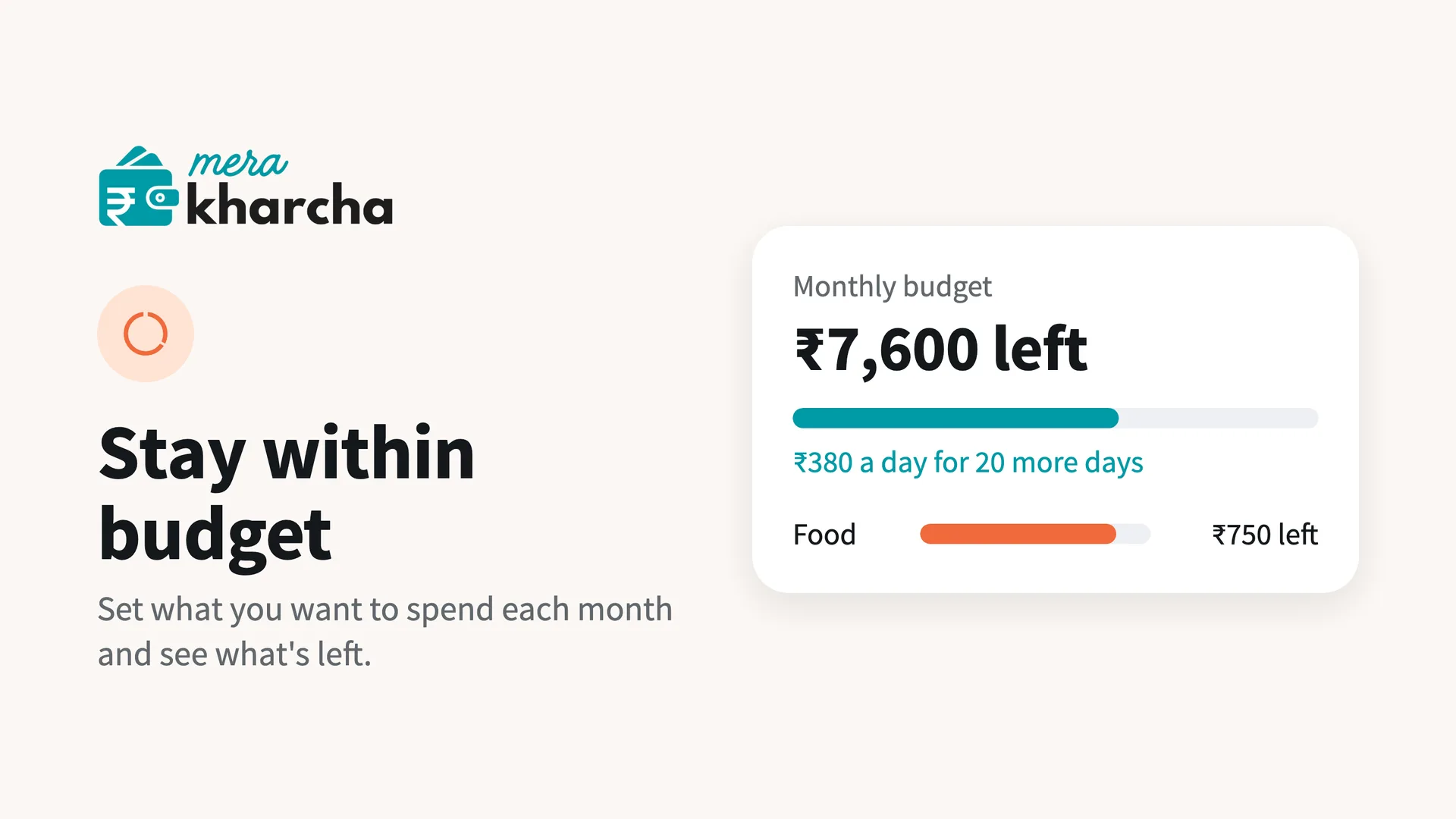
We built budgets into Mera Kharcha for exactly this. Set one amount for the month, or one each for ration, food, travel and the rest. It suggests an amount from your last 3 months. Add expenses as you go (cash too, or by voice with Premium) and Home shows "₹6,500 left, ₹650 a day". You get a notification at 80% and when a budget is used up, and you can look back at past months to see which ones went over. Budgets are free.
Mistakes that break a ghar ka budget
- Forgetting yearly kharcha. Insurance, school admission, festivals and repairs. Divide by 12 and keep it aside monthly.
- A zero budget for fun. It fails in a week. Keep a small, honest amount for eating out and outings.
- Leaving out cash. Doodh, sabzi and auto are often paid in cash, and they add up to thousands.
- Giving up after one bad month. The first month is for learning. Change the amounts and try again.
Common questions
Ghar ka monthly budget kaise banaye, in short?
Write your monthly in-hand income, list fixed bills like rent, EMIs and fees, take out savings on salary day, and split the rest into a few categories like ration, doodh-sabzi, travel and eating out. Then check what's left every few days.
How much should I save from a ₹30,000 salary?
Aim for ₹6,000 (20%). If rent and EMIs make that hard, start with ₹3,000 to ₹4,000 and raise it with every increment. Build an emergency fund of 3 to 6 months of expenses first.
How do I manage a ₹15,000 salary?
Keep rent and ration first, use only four or five categories, pay in cash or UPI that you record the same day, and save a small fixed amount, even ₹500, on salary day.
What do I do when the budget runs out before the month ends?
Don't stop tracking. Spread what's left over the remaining days, cut the wants category for the rest of the month, and next month raise the category that ran out or lower another to match.